The Greek Junta: From the Tanks in Athens to the Cyprus Tragedy
- #greece
- #greek-junta
- #cyprus
- #cold-war
The night of 20–21 April 1967 changed the course of modern Greek history. Using the pretext of a looming "communist threat," a group of mid-ranking army officers rolled tanks onto the streets of Athens and abolished democracy for seven years.
Here are the confirmed historical facts behind the scenes — the dictatorship's impact, and its real role in the national tragedy of Cyprus.
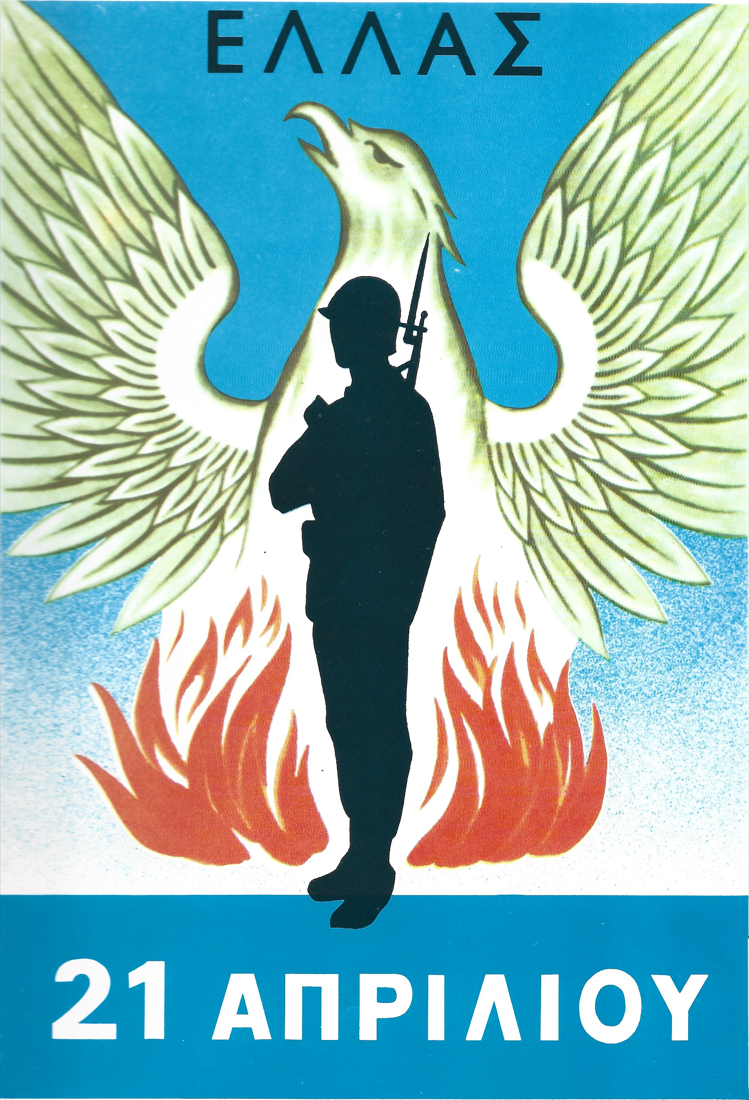
The regime's emblem — the silhouette of a soldier with a fixed bayonet and a phoenix rising from the flames. (Public domain, via Wikimedia Commons)
Why the coup happened, and who was involved
The coup did not happen in a political vacuum. Greece had been in deep political crisis since 1965 (the so-called Apostasia, or "Iouliana"), after King Constantine II's clash with the elected Prime Minister Georgios Papandreou pushed the country through a string of weak governments. Elections were scheduled for May 1967, and a victory for the Center Union (backed by the Left) was considered almost certain.
The protagonists
- The triumvirate: the main organizers were Colonel Georgios Papadopoulos (the mastermind), Brigadier Stylianos Pattakos (who moved the tanks out of the Goudi barracks) and Colonel Nikolaos Makarezos (the economic brain).
- King Constantine II: although caught off guard — the palace had been planning its own "royal" coup with senior generals — he ultimately signed the colonels' government into office, legitimizing it. In December 1967 he attempted a counter-coup to overthrow them, failed, and fled abroad.
- The role of the USA: because of the Cold War, the United States (and the CIA) knew a coup was brewing in Greece, but were taken by surprise by Papadopoulos's group specifically. Even so, Washington quickly accepted and backed the regime, since the junta safeguarded NATO's interests in the region and was fanatically anti-communist.
The confirmed dark side of the dictatorship
The seven years left deep wounds in society and political life. The most heavily documented harms include:
- Abolition of liberties: the Constitution was suspended. Political parties were banned, parliament was shut, and strict censorship was imposed on the press, music and the arts.
- Persecution, exile and torture: thousands of citizens (mostly leftists, but also right-wing democrats) were arrested. Many were exiled to barren islands such as Gyaros and Leros. The notorious EAT-ESA military police became synonymous with horrific torture.
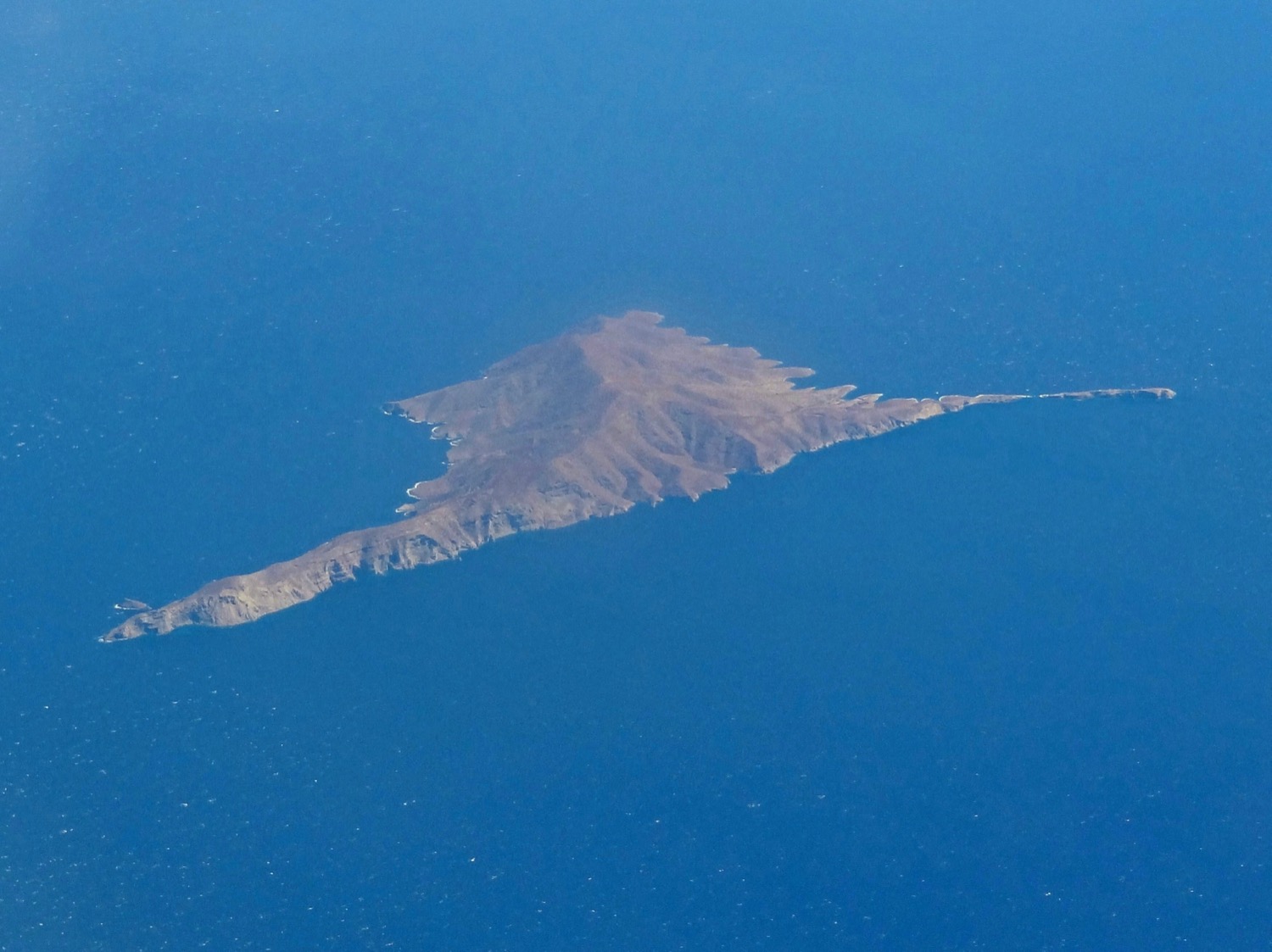

Gyaros, one of the barren islands used to exile dissidents. (Olaf Tausch, CC BY 3.0, via Wikimedia Commons)
- Economic mismanagement: despite the myth of a "healthy economy," the junta left behind a huge foreign debt. Its final years (1973–1974) were marked by galloping inflation and scandals (such as the infamous "rotten meat" affair).
Were there any "positives"? (the historical reality)
The regime used heavy propaganda to show it was getting things done. Historically there were a few measures recognized at the time as bringing relief, but with long-term costs:
- Cancellation of farmers' debts: in 1968 Papadopoulos wrote off farmers' debts to the Agricultural Bank. This won him popularity in the countryside, but significantly burdened the state budget.
- Infrastructure works: the road network was expanded, remote villages were electrified, and tourism was developed. Many of these projects, however, were handed out through direct, no-bid contracts to regime "friends," deepening corruption.
Cyprus: what was Papadopoulos's responsibility, and what happened?
Here lies a crucial historical detail that is often confused. The Turkish invasion of Cyprus ("Attila") in July 1974 did not happen under Papadopoulos.
Papadopoulos had already been overthrown in November 1973 (after the Polytechnic uprising) by the even more hardline Brigadier Dimitrios Ioannidis (the "invisible dictator"). Still, Papadopoulos bears enormous indirect responsibility for weakening Cyprus, while Ioannidis's junta bears the direct responsibility.
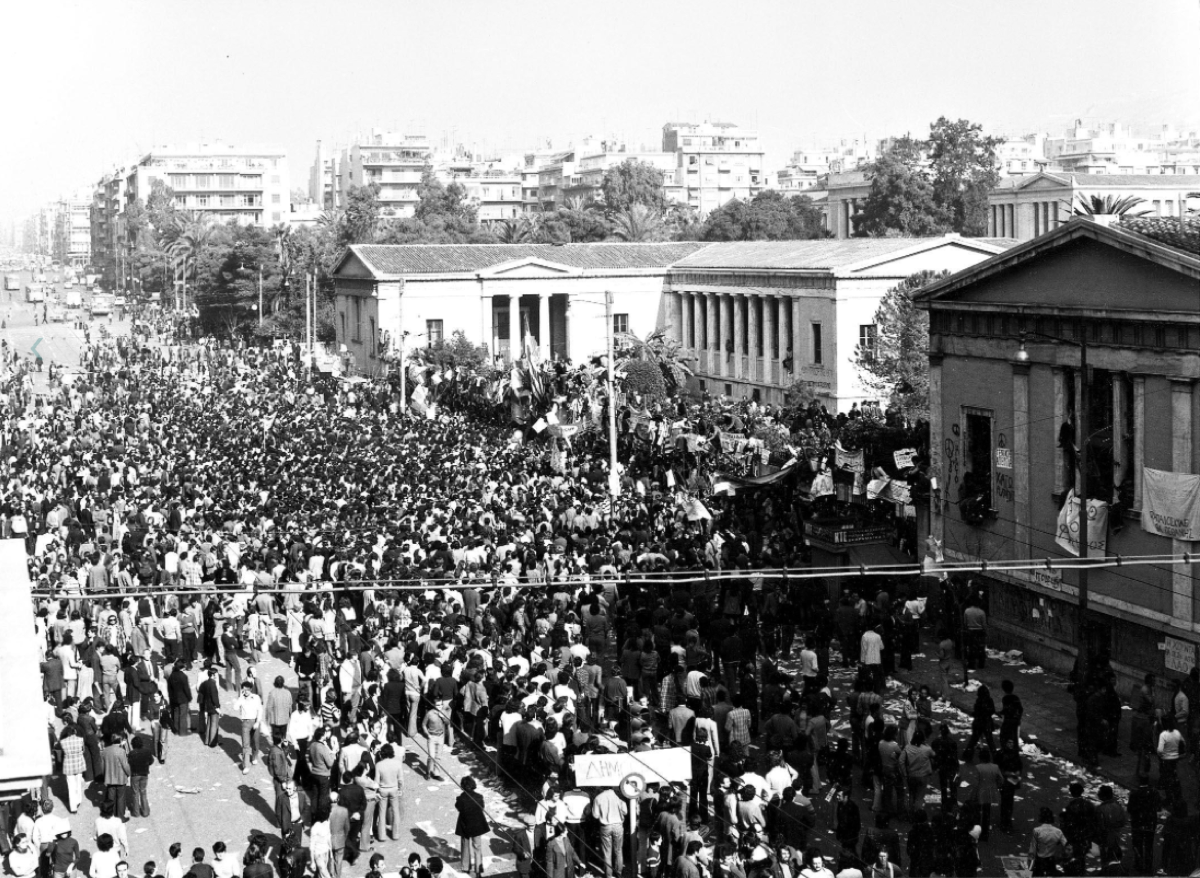

Protesters outside the Athens Polytechnic on Patission Street, November 1973. (Unknown author, CC BY-SA 4.0, via Wikimedia Commons)
How we were led to the catastrophe:
- Withdrawing the Greek division (1967): Papadopoulos's first major blunder. After a crisis in Cyprus (the Kofinou events), he bowed to pressure from Turkey and the USA and pulled out the Greek army division that Georgios Papandreou had secretly sent to protect the island. This left Cyprus militarily exposed.
- Undermining Makarios: Papadopoulos's junta saw Archbishop Makarios (President of Cyprus) as a "red priest" because he kept a non-aligned policy and had ties with the USSR. It founded and backed the terrorist organization EOKA B′ to fight him.
- The fatal coup (15 July 1974): Papadopoulos's successor, Ioannidis, took the final, insane step: he ordered a coup in Cyprus to overthrow and assassinate Makarios. Makarios escaped, but the coup handed Turkey the legal pretext it had been seeking for years to intervene as a "guarantor power."
- The invasion (20 July 1974): five days later, Turkey invaded Cyprus. The mobilization the junta declared in Greece was utter organizational chaos, proving that the regime — for all its big talk — had wrecked the fighting capability of the armed forces.
Timeline of the seven years
- 21 April 1967 — The coup: Papadopoulos and his associates seize power; democratic liberties are suspended.
- November 1967 — Withdrawal of the Greek division: the junta pulls Greek troops out of Cyprus, leaving the island exposed.
- November 1973 — The Polytechnic uprising: students rise up; the bloody crackdown shatters the "liberalization" image Papadopoulos was trying to project.
- 25 November 1973 — Papadopoulos overthrown by Ioannidis: Dimitrios Ioannidis topples Papadopoulos in an internal coup, imposing an even harsher regime.
- July 1974 — Coup in Cyprus & Turkish invasion: Ioannidis's junta overthrows Makarios; the Turkish invasion and the collapse of the dictatorship in Greece (the Metapolitefsi) follow.
The bottom line
Georgios Papadopoulos opened Pandora's box. Although he was not in power when the invasion happened, his own regime militarily weakened Cyprus, divided Hellenism, and rolled out the carpet for the catastrophe of 1974.
Image credits
- Junta emblem — April21st (poster), public domain, via Wikimedia Commons.
- Athens Polytechnic, 1973 — unknown author, CC BY-SA 4.0, via Wikimedia Commons.
- Gyaros — Olaf Tausch, CC BY 3.0, via Wikimedia Commons.
Source: Wikipedia — Greek junta