Why the US dropped atomic bombs on Japan
- #wwii
- #japan
- #nuclear
- #1945
In August 1945, the United States dropped two atomic bombs on the Japanese cities of Hiroshima (August 6) and Nagasaki (August 9). The bombings of Little Boy and Fat Man resulted in the immediate and painful deaths of an estimated 150,000–246,000 people, primarily civilians.
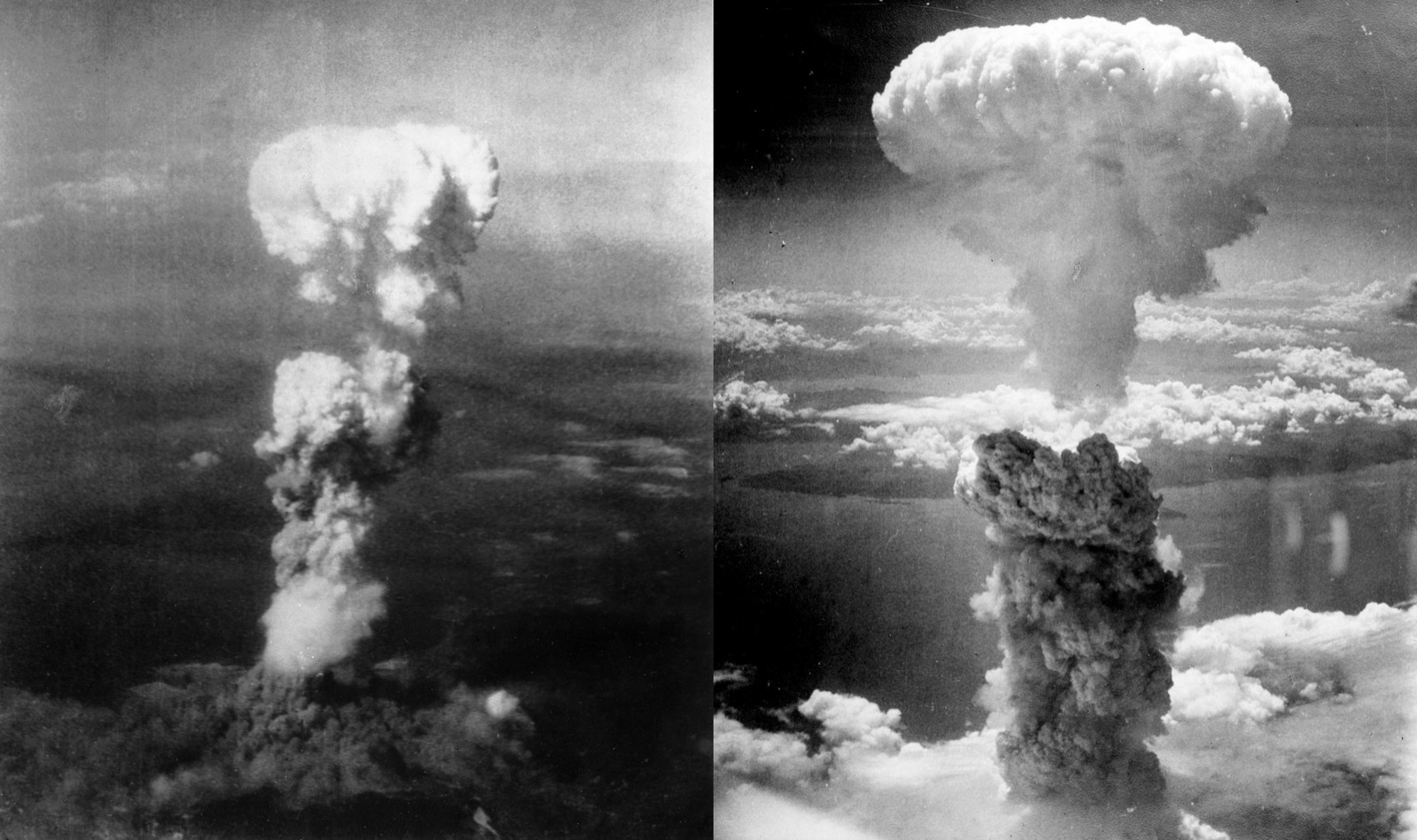

Mushroom clouds over Hiroshima (left) and Nagasaki (right), 1945 — George R. Caron / Charles Levy · Public domain · via Wikimedia Commons
The decision to deploy the world's first nuclear weapons remains one of the most intensely debated choices in modern history, balancing military necessity against political posturing and human tragedy.
The Manhattan Project and Weapon Physics
The creation of the bombs was the result of the Manhattan Project, a top-secret research program led by physicist J. Robert Oppenheimer and US Army General Leslie Groves. The project succeeded in designing two distinct types of nuclear weapons:
- Little Boy (Uranium-235): Deployed on Hiroshima. It used a relatively simple gun-type assembly, which fired a subcritical projectile of uranium-235 into a subcritical target cylinder to initiate a supercritical mass and nuclear chain reaction.
- Fat Man (Plutonium-239): Deployed on Nagasaki. Plutonium cannot be detonated using a gun-type method because it undergoes spontaneous fission too quickly, pre-detonating and fizzling out. Instead, it used a highly complex implosion design: a sphere of plutonium-239 was surrounded by explosive lenses that detonated simultaneously, compressing the plutonium to critical density.
The Official Military Justification
The official justification presented by President Harry Truman and Secretary of War Henry Stimson was purely military.
- The Allies were preparing for Operation Downfall, a massive amphibious land invasion of the Japanese home islands.
- Based on the fierce resistance encountered at Iwo Jima and Okinawa, military planners estimated that a land invasion would cost hundreds of thousands of Allied lives and potentially millions of Japanese casualties.
- Under this view, the atomic bombs were a necessary military measure to force an immediate, unconditional Japanese surrender and bring World War II to a rapid end.
The Contested Reason: Atomic Diplomacy and the Soviet Factor
Many historians, notably Gar Alperovitz, argue that the military justification was secondary. They present a different thesis based on geopolitical chess:
- The Potsdam Declaration: In July 1945, the Allies issued the Potsdam Declaration demanding Japan's unconditional surrender. Prime Minister Kantaro Suzuki responded with the term mokusatsu (literally "to kill with silence" or "to treat with silent contempt"), which the US interpreted as a rejection.
- The Soviet Invasion of Manchuria: At the Yalta Conference, Joseph Stalin promised to enter the war against Japan three months after Germany's defeat. On August 9, 1945, precisely on schedule, the Soviet Red Army launched a massive surprise invasion of Japanese-occupied Manchuria (Operation August Storm).
- The Surrender Decision: Many historians argue that the Soviet declaration of war and the rapid collapse of the Kwantung Army played a larger role in Japan's surrender than the atomic bombs. The entry of the USSR eliminated Japan's hope of a negotiated peace mediated through Moscow.
- Atomic Diplomacy: Under this theory, the US dropped the bombs not to prevent an invasion, but to demonstrate its nuclear monopoly to the Soviet Union, hoping to limit Soviet expansion in Asia and secure a dominant position in the emerging Cold War.
The Human Legacy
Regardless of the geopolitical motives, the human cost was devastating. The immediate blast was followed by the slow, painful agony of radiation sickness (acute radiation syndrome) and thermal burns. Standing today in Hiroshima, the Genbaku Dome (Hiroshima Peace Memorial)—the skeletal dome of the Industrial Promotion Hall left standing near the hypocenter—remains a powerful monument advocating for global peace and nuclear disarmament.
📍 This made me want to visit
Hiroshima & Nagasaki, Japan
Source: Atomic Heritage Foundation